250,000 tonnes of ice over Randa: the glacier that could cut the road to Zermatt
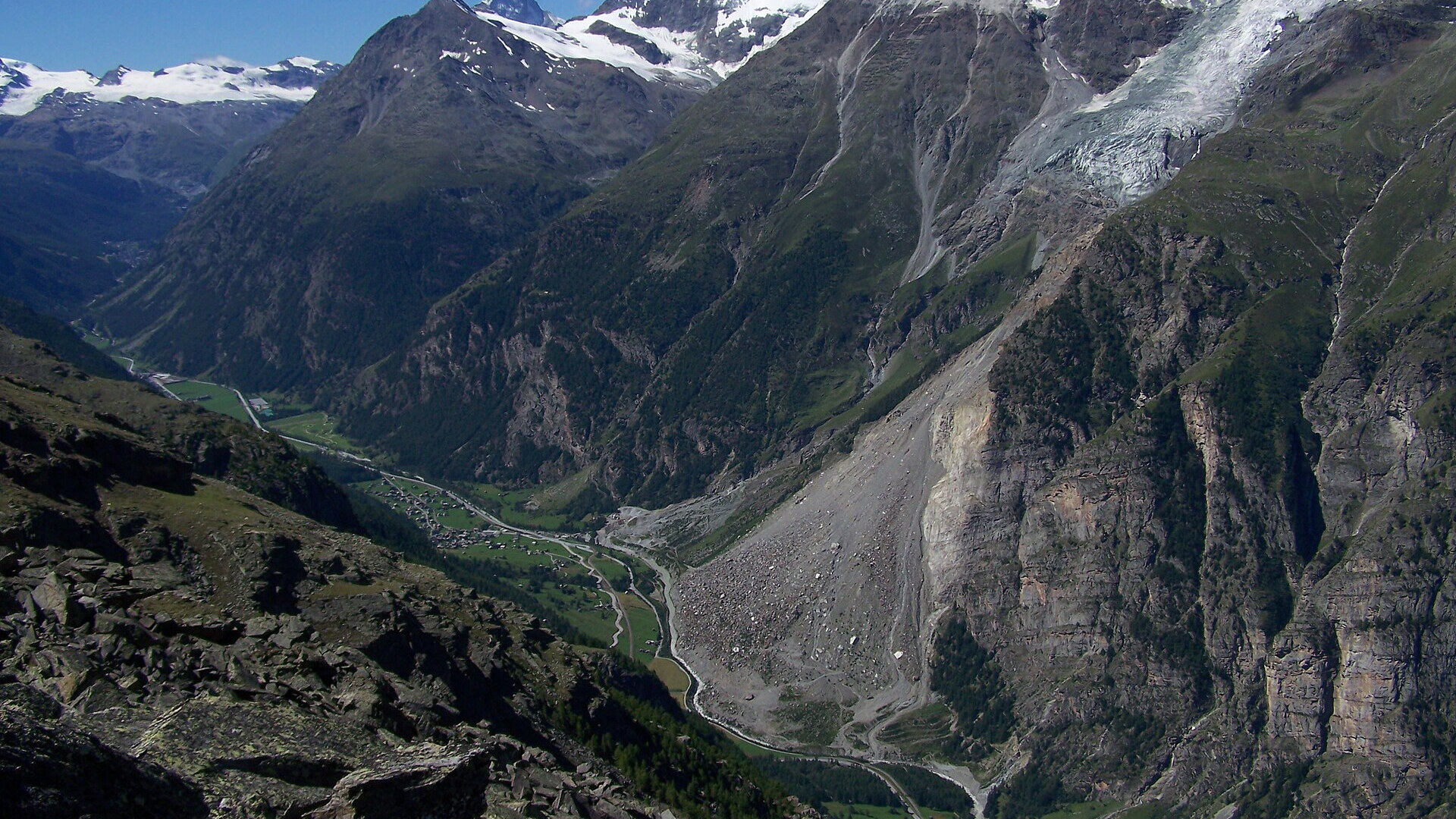
The Mattertal at Randa in July 2007; the fan on the western slope is from the 1991 rockslide. Photo: Woudloper via Wikimedia Commons, public domain, cropped
A block of ice of about 300,000 m³, around 250,000 tonnes, hangs on the east face of the Weisshorn above Randa, the village 9 km below Zermatt, and is sliding downhill at up to 20 cm a day, the canton's natural-hazard engineer Norbert Carlen told the Walliser Bote on Thursday 22 October 2026. The first snow changes the sums: a fall onto a snow-covered plateau would become an ice-and-snow avalanche with a far longer reach. The village is not in the path. The road and the only railway to Zermatt are.
In short
- The hanging glacier Weisshorn East has been under closer watch since June 2026 and at level 3 since 24 August; the exclusion zone west of the village stays closed.
- About 200,000 m³ of ice fell at the end of the summer; about 300,000 m³ remain and move up to 20 cm a day, according to Carlen in the Walliser Bote.
- Fresh snow on the Bisgletscher plateau below the block would be swept along in a collapse; a mild November that lets the ice crumble in portions is the better scenario.
- Automatic lights stop road and rail traffic in a major collapse; in February 1986 an ice avalanche buried both over 200 m, in March 2005 460,000 m³ fell without harm.
- Zermatt is car-free: visitors park in Täsch, one village above Randa, and take the shuttle train; the Winter Opening Weeks start on 1 November.
What hangs above Randa
The object is a small hanging glacier north-east of the 4,505 m Weisshorn summit that overhangs the Bisgletscher, as RTS described it on 25 August. Two scenarios are possible, the head of the cantonal natural-hazard service, Guillaume Favre-Bulle, told the broadcaster: either the glacier breaks up piece by piece, or the whole unstable mass goes at once. In July Carlen had said that experience shows the glacier mostly breaks "in portions", Tages-Anzeiger reported.
On 22 October the Walliser Bote published a new interview with Carlen, picked up the same day by Le Matin, Rhône FM, watson, Blick, tio.ch and t-online. The block of about 300,000 m³, "around 250,000 tonnes" in the Swiss reports, pushes downhill at up to 20 cm a day; the danger is assessed every day with cameras and a movement sensor. "Personally, that gives me a bit of a stomach ache," Carlen said, in our translation of watson's German text. All October figures trace back to that one interview; as of 26 October 2026 neither the municipality nor the canton has published a new notice.
The timeline since June
| Date | Event | Source |
|---|---|---|
| End of June 2026 | Closer monitoring, danger perimeter marked, trail and gravel works closed | Gemeinde Randa |
| 24 August 2026 | Monitoring raised to level 3; at least three break-offs in the afternoon, the largest between 17:00 and 18:00; deposits stay on the glacier plateau | Gemeinde Randa |
| 25 August 2026 | Municipality: "The settlement area is not affected by the current situation" | Gemeinde Randa |
| End of summer 2026 | About 200,000 m³ of ice fall | Walliser Bote via Le Matin |
| 22 October 2026 | First snow; Carlen: 300,000 m³ left, up to 20 cm a day | Walliser Bote via Swiss media |
The municipal notices of 24 August and 25 August are still the latest on randa.ch. The perimeter west of the village may not be entered, the access paths for walkers and cyclists stay closed, and an interferometric radar was installed for the event. The built-up village lies outside the closed area.
What fresh snow changes
Snow on the steep ice slope slides off anyway. Snow on the flatter plateau of the Bisgletscher below the block is the problem: in a collapse it would be swept along, and the result would be a fast, combined ice-and-snow or powder avalanche with a reach many times greater than a summer ice fall, Carlen explained. A metre or more of fresh snow could settle on that plateau in the coming weeks. A mild November, in which the ice crumbles in parts, would ease the risk.
Blick added an independent voice. The extreme case would be a collapse during a period of high avalanche danger, which could set off further snow avalanches, Stefan Margreth of the Swiss snow and avalanche institute SLF told the paper: "On the one hand the ice avalanche has to break off, and at the same time there has to be an extreme avalanche situation. That is rather unlikely," in our translation. High or very high avalanche danger occurs on fewer than 5 percent of winter days, he said.
The road and the rail to Zermatt
Randa, about 1,400 m high with 448 inhabitants on 1 January 2026, lies on the Matter Vispa between Visp and Zermatt. The cantonal road and the Matterhorn Gotthard Bahn, the only railway into the upper valley, pass below the Bisgletscher. Ice masses that break off the Weisshorn's hanging glacier "can reach the road and railway tracks in direction of Zermatt as a combined ice and snow avalanche", the monitoring company Geopraevent wrote in 2018. In a major collapse, lights stop road and rail traffic automatically, 24 heures reported. Part of the line lies inside the perimeter, with passage allowed through the alarm link. Trains ran normally in late August, IamExpat noted, and no closure has been reported between 22 and 26 October.
The record explains the caution. On 4 February 1986 an ice avalanche from the Bisgletscher buried the Visp–Täsch road and the railway over 200 m, the ETH glaciology lab VAW wrote in 2005; on 23 and 30 March that year 460,000 m³ of ice came down in two falls without threatening Randa, because little snow lay in the 3,000 m long path. In January 1636 a combined ice-and-snow avalanche killed 37 people in the village, 20 Minuten recalled; the rockslides of April and May 1991 on the opposite slope dammed the river and flooded part of the village.
If you go to Zermatt
Zermatt has no cars: private vehicles stop at the Matterhorn Terminal in Täsch, with 2,100 covered parking spaces and a 12-minute shuttle train, Zermatt Tourismus explains, and both the road to Täsch and that train pass Randa. Glacier skiing for guests resumed on 14 October, Zermatt Bergbahnen announced, and the Winter Opening Weeks run from 1 November to 6 December 2026. Early-season glacier pistes are firm snow, where a narrow waist and a short radius count: with the makers' figures, the Stöckli Laser WRT has a 66.5 mm waist and a 12.3 to 16 m radius, the Head Worldcup Rebels e-Speed 68 mm and 15.1 to 19.4 m, and the Kästle RX12 GS 68 mm and 17.2 m at 178 cm. The Pick-a-ski tool ranks the whole catalog on edge grip for days like these.
Sources
- Gemeinde Randa, safety notice of 24 August and press release of 25 August 2026; Kanton Wallis communiqué list (no Randa notice found, 26 October 2026)
- Walliser Bote interview with Norbert Carlen, 22 October 2026, as reported by Le Matin, Rhône FM (Keystone-ATS), 24 heures, watson, Blick, 20 Minuten, tio.ch, t-online (22 October), The Local (23 October) and SnowBrains (25 October)
- RTS, Tages-Anzeiger, swissinfo and blue News, 25 to 28 August 2026; IamExpat, 26 August 2026
- Geopraevent, 23 November 2018; VAW / ETH Zürich releases of 3 February and 1 April 2005 via RAOnline
- Zermatt Tourismus (arrival, Winter Opening Weeks), Zermatt Bergbahnen (resumption of skiing, 14 October 2026), Matterhorn Gotthard Bahn (Matterhorn Terminal Täsch); Wikipedia (Randa population and altitude, Federal Statistical Office 2026)
- Pick-A-Ski catalog, makers' figures for the models named above