Where Do K2 Skis Come From? The Story From Dog Cages to the Pontoon
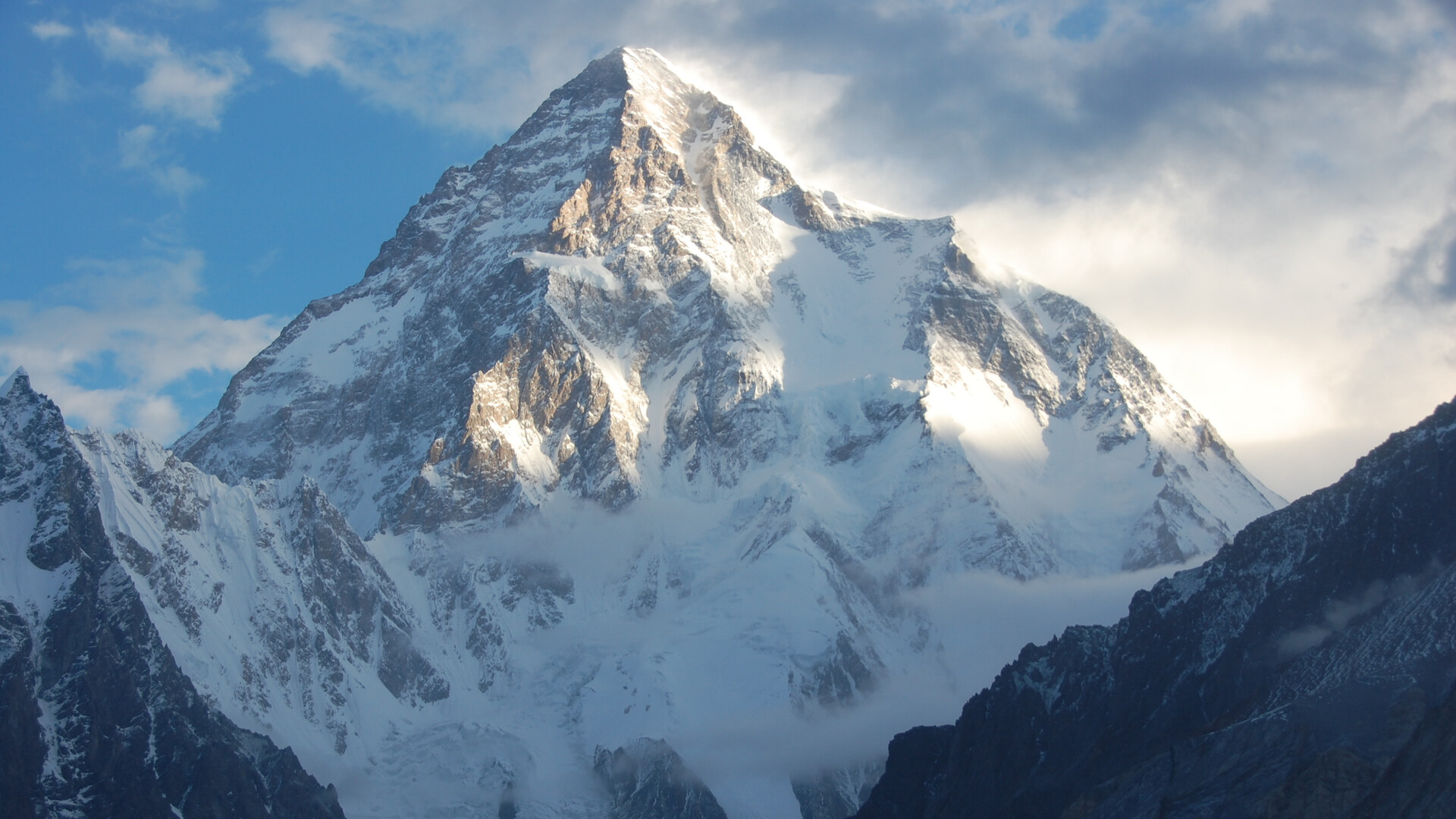
K2 in the Karakoram, the mountain that gave the brand its name. Photo: Maria Ly via Wikimedia Commons, CC BY 2.0
K2 did not start as a ski company. It began as a small fiberglass factory on Vashon Island near Seattle that made splints and cages for dogs and lab animals. In 1961 Bill Kirschner wrapped that fiberglass around a pair of skis, and by 1968 the island shipped 21,000 pairs a year. The brand that followed won World Cups, then chose fun over racing, and in 2006 put the shape of the Pontoon on the map. In 2026 nearly every powder ski has rocker.
In short
- The first K2 skis were made in 1961 on Vashon Island, Washington, by Bill Kirschner, an engineer whose family firm made fiberglass animal cages.
- The first 250 pairs reached shops in 1964. In 1967 the ski business got its name, K2, after the mountain and the two Kirschner brothers. In 1968 it shipped 21,000 pairs.
- Marilyn Cochran won the 1969 World Cup giant slalom title on K2 skis, the first American World Cup discipline title. Phil Mahre won the overall World Cup in 1981, 1982 and 1983 on K2.
- K2 says it was the first brand to engineer skis specifically for women, with the Women's Alliance of 1999.
- The Pontoon of 2006, shaped with Shane McConkey, started with maybe 1,000 pairs and stayed in the line for 17 years. Production moved to China in 2001; the company is owned by a private equity firm since 2017.
The video tells the whole story in under 5 minutes. This guide adds the dates, the sources and the parts the video left out.
The island: Vashon and the Kirschner family
Vashon Island lies in Puget Sound, west of Seattle, and you can only reach it by boat. After the Second World War the Kirschner family ran a small factory there, Kirschner Manufacturing. It made veterinary splints and chew-proof cages for research laboratories, all from fiberglass. The company grew into a major supplier of research-lab cages.
Bill Kirschner was born in Seattle in 1918 and took an engineering degree at the University of Washington in 1939. He knew fiberglass better than anyone in skiing did. Skis were not the plan. They were a hobby, and the hobby kept breaking.
1961: the wet wrap
Through the 1950s Kirschner built one prototype after another. Most of them broke apart on the slopes of Crystal Mountain. In 1961 he tried a different process, a wet wrap: fiberglass soaked in resin, wrapped around a light core and pressed in a mold. He took the trial pair to Sun Valley, and it held.
He was not the first to make a fiberglass ski. A Swiss maker had patented one in 1958. The European factories of the time built fiberglass skis by armouring stiff hickory race skis in glass; Kirschner's ski was light and resilient, made for the soft snow of the American West. His design is the one that would be built by the thousands.
From 250 pairs to a name: 1964 to 1968
A Seattle ski distributor, Anderson & Thompson, agreed to sell the new ski. It was called the Holiday. The figures from HistoryLink and Skiing History tell the growth:
| Year | Pairs delivered | Note |
|---|---|---|
| 1964 | 250 | The first skis reach the market |
| 1965 | 1,600 | Distributed by Anderson & Thompson |
| 1967 | – | The ski business is split off and named K2 |
| 1968 | 21,000 | Payroll grows from one machinist to 83 people |
The name came in 1967, when Bill Kirschner separated the ski business from the cage business. K2 stands for the second-highest mountain on earth and for the two Kirschner brothers, Bill and Don. K2 itself counts its founding from 1962.
The racers: Cochran and the Mahre twins
In 1968 Kirschner hired Chuck Ferries to develop a race ski. Ferries tried the prototypes with Marilyn Cochran, and in 1969 she won the World Cup giant slalom season title on K2 skis. She was the first American to win a World Cup discipline title.
In 1971 two twins from Yakima, Washington, joined the brand: Phil and Steve Mahre. Phil Mahre won the overall World Cup three years in a row, in 1981, 1982 and 1983, with 27 World Cup wins in total. At the 1984 Olympics in Sarajevo he took slalom gold, and Steve took silver 0.21 seconds behind him. Steve was also the 1982 world champion in giant slalom. Both brothers raced on K2 throughout their careers.
K2 no longer makes race skis. Our catalog lists 65 K2 skis in November 2026, from 66 mm to 132 mm at the waist, and not one of them is a race ski.
Why K2 chose fun
Fun has been the centre of the brand since the 1980s. K2 backed ski films: Glen Plake with the mohawk, Mike Hattrup and Scot Schmidt, the stars of Greg Stump's Blizzard of Aahhh's, were on K2. The marketing was van tours, odd advertisements and parties on snow. In 1987 K2 added snowboards. The president of K2 Japan summed it up in 2012: "Fun is what really describes the company."
K2's own about page says the same in 2026. The brand wants to "prioritize fun and freedom in the face of the rat race" and says it is there for "the ski bums, the dirtbags, the rebels, and everyone else who carves their own path".
The engineering did not stop: the K2 Four (1995)
In the autumn of 1995 K2 launched the Four, the first ski with a piezoelectric damper. A strip of smart material turns vibration into a tiny electric charge, and that calms the ski. Popular Science gave the Four a gold medal for performance innovation in 1996. According to K2's own history, the Four was the best-selling ski in America in the 1996/97 season, and K2 held the largest US market share of any ski brand that season.
The Women's Alliance (1999)
In 1999 K2 put a group of women skiers in charge of designing skis for women and called it the Women's Alliance. K2 says it was the first brand to engineer products specifically for women. The series that followed was named T:Nine, after Title IX, the American law on equal opportunity in school sports. In 2026 every big maker has a women's line.
The factory leaves the island
At its peak the Vashon factory employed 750 people, and K2 was the island's biggest employer. Then prices fell. In November 1999 K2 announced it would cut half the plant's workers and move those jobs to China, to compete with cheaper imports. By 2001 production had moved to Guangdong, China. In 2006 the offices followed to Seattle's industrial district. The factory stood empty for more than ten years, until it was sold in 2018.
The Pontoon: the ski nobody wanted (2006)
Shane McConkey, a K2 team skier, had an idea the industry did not want: a very wide ski with the tip and the tail bent up, like a water ski. K2's own people were skeptical. Mike Hattrup, then in charge of K2's backcountry line, remembers: "We made, maybe 1,000 pair that first year." That ski was the Pontoon, in 2006. It sold out and stayed in the line until 2023. McConkey died in 2009.
The idea outlived the ski. By 2012 K2 rockered every ski in its line to some degree, and in 2026 nearly every powder ski has rocker. If your skis float in deep snow, that shape goes back to the Pontoon.
Who owns K2 in 2026
The Kirschners sold control early. The owners changed many times:
| Period | Owner |
|---|---|
| around 1970 to 1976 | Cummins Engine Company, Indiana |
| 1976 to 1985 | Sitca, a group of Northwest investors, then its management |
| 1985 to 2007 | Anthony Industries, a swimming-pool maker, renamed K2 Inc. in 1995 |
| 2007 to 2017 | Jarden, later Newell Brands |
| since 2017 | Kohlberg & Company, private equity |
Since 2017 K2 shares a parent with Völkl, Marker, Dalbello, Line and Ride. That parent, K2-MDV Holdings, renamed itself Elevate Outdoor Collective in February 2022. Its headquarters are in Seattle.
What the story does not tell you about a K2 in 2026
Do not buy a K2 for the island. The skis have been made in China since 2001, like most skis of most brands outside Europe. Do not look for the Pontoon either: it left the line in 2023. And do not expect a race ski. The K2 line of 2026 runs from the 66 mm 244 mogul ski to the 132 mm Crescendo powder ski, with the Mindbender family in the middle.
What the story does tell you is what K2 optimises for. Read our reviews of the K2 Mindbender 96, the K2 Reckoner 102 and the K2 Disruption 78C for what that means on a specific ski.
Find the ski that fits
A brand story is a reason to like a brand, not a reason to buy a ski. The ski has to fit your level, your terrain and your size. The Ski Selector asks a few questions and takes about 2 minutes, and it ranks K2 skis next to every other brand in our catalog.
Sources
- Skiing History, Seth Masia, "Bill Kirschner": the cages, the 1961 wet wrap, the Holiday, Cochran, the Cummins sale, skiinghistory.org, read on 8 November 2026
- HistoryLink essay 3901, Andy Luhn, "K2 Corporation (K2 Sports), a History": the pairs per year, the name, the owners, the Four, historylink.org, read on 8 November 2026
- K2, "About K2" and "Celebrating 60 Years": founding 1962, snowboards 1987, Women's Alliance 1999, the "fun and freedom" line, k2snow.com, read on 8 November 2026
- Outdoor Japan Traveler, Bill Ross, "A Focus on Fun: Celebrating 50 Years of K2 Skis" (2012): the film stars, the Mahres, the K2 Japan quote, outdoorjapan.com, read on 8 November 2026
- Wikipedia, "Marilyn Cochran", "Phil Mahre", "Steve Mahre", "K2 Sports": the race results, the 2001 move to China, the ownership chain, en.wikipedia.org, read on 8 November 2026
- Seattle Times archive, 20 November 1999 and 23 June 2006: the layoffs, the move to Seattle, archive.seattletimes.com, read on 8 November 2026
- Vashon-Maury Island Beachcomber, 8 July 2009: 750 employees at the peak, vashonbeachcomber.com, read on 8 November 2026
- Backcountry Magazine, Adam Howard, "Look Back, Rise Up" (2025): the Pontoon, Hattrup's quote, 2006 to 2023, backcountrymagazine.com, read on 8 November 2026
- Vashon-Maury.com, "The History of K2 on Vashon Island": the empty factory and its 2018 sale, vashon-maury.com, read on 8 November 2026
- Pick-a-Ski catalog, read-only count on 8 November 2026: 65 K2 skis, waist 66 to 132 mm