Why Are Skis So Expensive? Where $600 for a Pair Goes
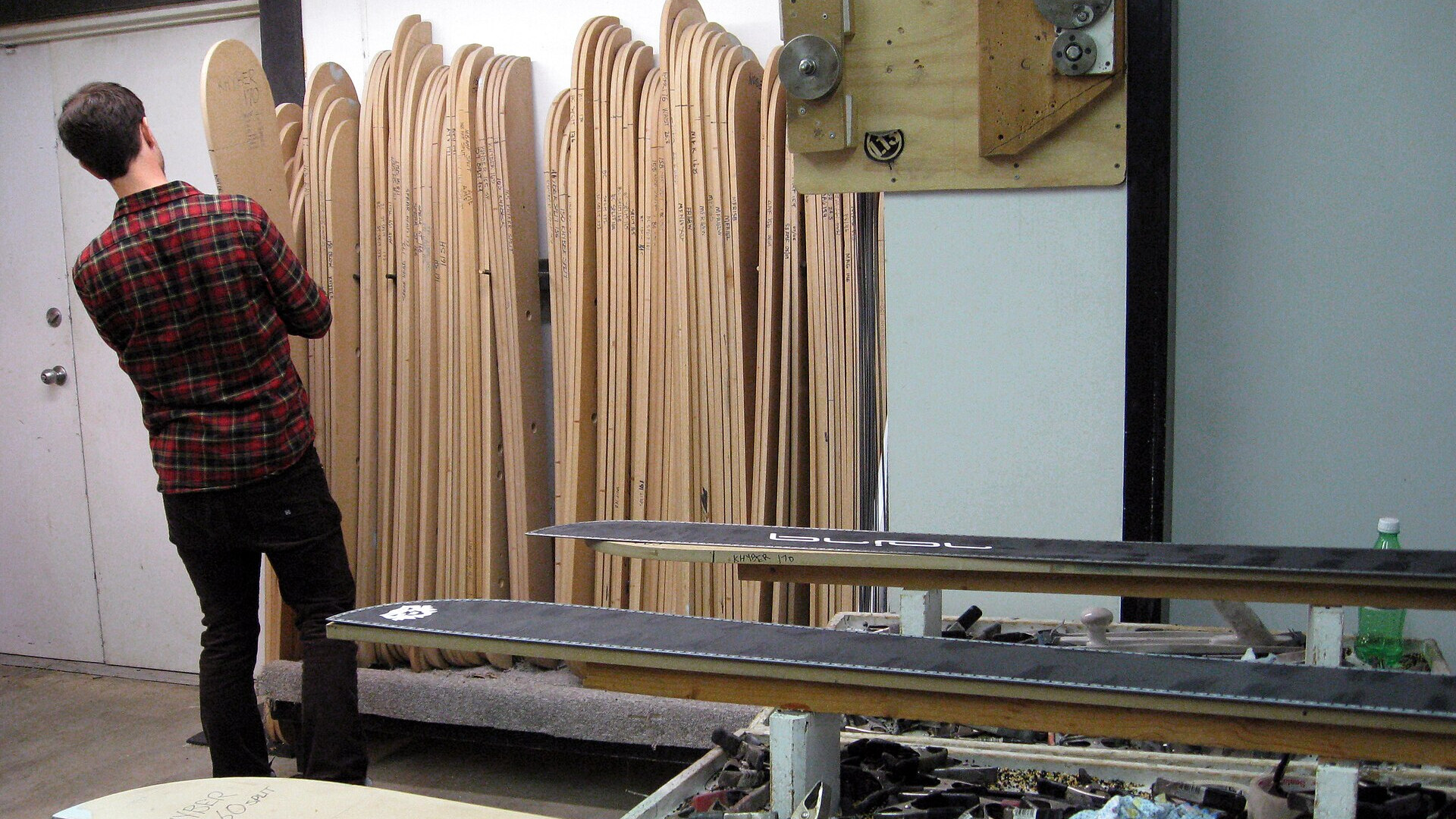
Wooden ski and snowboard forms and the workbench where the metal edges go on, at the Prior factory in Whistler, Canada, in 2008. Photo: Ruth Hartnup via Wikimedia Commons, CC BY 2.0, cropped
On a $600 pair of skis, the shop keeps about $300, the factory gets $200 and the brand is left with $100. That is the example of Jason Levinthal, the founder of Line Skis. Nobody in that chain gets rich: skis are made in small numbers, in thousands of sizes, and largely by hand. And in 2026 dollars, a pair cost more in 1975 than it does in 2026.
In short
- In one founder's example, a $600 pair splits into $300 for the shop, $200 for the factory and $100 for the brand.
- In Europe, VAT of 19% to 22% is inside the price tag: about one sixth of what you pay. The United States charges 10% duty on skis from the EU (November 2026).
- 25 leading brands together sold 3.67 million pairs of alpine skis in the 2022-23 season. The world made 23.9 billion pairs of shoes in 2024.
- Our catalog lists 1,374 ski models. Count every length, and that is 5,886 different skis.
- The average pair in Ski magazine's buyers' guide for 1975 cost $190. That is about $1,270 in 2026 dollars.
The video follows one pair through all four hands in under 5 minutes. This guide adds the figures as tables and the sources.
Where the $600 goes
No ski brand publishes what one pair costs to make and to sell. Two sources come close.
The first is Jason Levinthal, who founded Line Skis and later J Skis. In a podcast interview from May 2026 he counts his own money for a ski sold through shops, with $600 as an easy round number. The second is an article in Ski magazine from September 2005, with figures from the trade group SnowSports Industries America for an $800 pair.
| Who | Founder's example, 2026 ($600 pair) | Ski magazine, 2005 ($800 pair) |
|---|---|---|
| The shop | $300 (50%) | $336 (42%) |
| The distributor | not in the example | $153 (19%) |
| The brand, after production | $100 (17%) | about $155 (19%) |
| The factory: production cost | $200 (33%) | $155 (19%) |
The two counts are 21 years apart and they agree on the picture: the shop takes the largest slice, and the ski itself is a third of the price or less. Both leave out the first hand, because it differs per country: the government.
The government: tax and duty
In the United States, state and local sales tax comes on top of the shelf price at the register. In Europe the tax is already inside the price tag:
| Country | VAT rate | Share of the shop price |
|---|---|---|
| Germany | 19% | 16.0% |
| Austria | 20% | 16.7% |
| France | 20% | 16.7% |
| Netherlands | 21% | 17.4% |
| Italy | 22% | 18.0% |
So in most ski countries about one sixth of what you pay never reaches the shop.
A ski that crosses a border also pays duty, on its value at import. The normal US rate for alpine skis is 2.6%. In November 2026 the US tariff schedule sets 10% for products from the European Union with a normal rate under 10%, and that includes skis. This rate has changed several times since April 2025, so check it before you rely on it.
The shop: about half
In Levinthal's example the shop buys at $300 and sells at $600. Ski magazine's figure from 2005 is close: an average markup of 42%, or $336 on an $800 pair.
That is not $300 of profit. The markup pays the rent, the staff and the marketing first. It also counts from the list price, which buyers who shop around rarely pay, so the real margin is usually lower. And every pair that is still on the wall in March goes on sale.
The brand: the smallest slice
The brand gets $300 from the shop and sends $200 to the factory. The $100 that is left is not profit. It pays for the designers, the race team and the marketing. The brand is also the bank: Levinthal says shops traditionally got about six months to pay.
What is left at the end of the year is small:
- Tecnica Group, the owner of Nordica and Blizzard, had revenues of €541.3 million in 2025 and a net income of €7.9 million. That is 1.5 cents of every euro, for the whole group with its boot and shoe brands.
- Fischer lost €10.5 million in its 2024-25 business year, on revenues of almost €120 million.
Tim Petrick, then vice president of K2 Sports, said it in Ski magazine in 2005: "Nobody is getting rich selling skis on the supplier side." For the companies behind the logos, read who really makes your skis.
The factory: three reasons a ski cannot cost less
In Levinthal's example the factory gets $200: one third of the price for the wood, the steel, the plastic and the work. The 2005 count puts production near one fifth. Why can a factory not go lower? There are three reasons, and none of them is greed.
There are almost no skis. FESI, the federation of the European sporting goods industry, counted 3,672,962 pairs of alpine skis sold by 25 leading brands between March 2022 and March 2023. The world made 23.9 billion pairs of shoes in 2024: about 6,500 pairs of shoes for every pair of skis. The business is so small that, according to the steel maker voestalpine, only two companies in the world make ski edges. A ski factory never reaches the scale that makes things cheap.
Every length needs its own tooling. A ski is pressed in a heated mold. A patent on ski presses from 2024 describes the usual method: the mold is designed for one ski model, "i.e., a specific ski length and bow line". The pick-a-ski.com catalog lists 1,374 models from 41 brands in 5,886 combinations of model and length. Models with the same shape and a different top sheet can share a mold, so this is the number of different skis, not of molds. But each one needs its own setup, its own press run and its own shelf in a warehouse.
The work is done by hand. A ski is a stack of thin layers: base, edges, wood core, fiberglass, top sheet. Somebody lays them up. At Atomic's factory "each ski is assembled by hand", in 30 to 40 steps that depend on the model. Stöckli counts "over 140 manual steps" in one of its skis; the two makers do not count the same things. At Völkl, each ski then stays in the press for 23 minutes.
Skis got cheaper, not more expensive
The list price went up. The value of a dollar went down faster.
| Year | Ski | List price | In 2026 dollars |
|---|---|---|---|
| 1975 | Average pair in Ski magazine's buyers' guide | $190 | about $1,270 |
| 2005 | Völkl Mantra | $765 | about $1,300 |
| 2026 | Völkl M7 Mantra | $899.99 | $899.99 |
All three are US list prices without bindings, converted with the US consumer price index up to October 2026. For the 1975 guide we took the index of September 1974, the autumn before that season; with the average index of 1975 the figure is about $1,190.
The Mantra is the clearest case. The name is the same, the ski had 20 years of development, and the Völkl M7 Mantra lists at about $400 less than the 2005 Mantra in 2026 dollars.
What the price does not tell you
The price of a ski tells you how it was built and how few were made. It does not tell you if the ski fits you. The most expensive ski in the shop is the wrong ski if it was built for a different skier.
So do not use the price as a score. Decide first what you need: the width, the shape and the right length. Then compare prices between the skis that fit. Pay for the fit, not for the tag.
Find the ski that fits
The Ski Selector compares the skis in our catalog on the things that matter on snow, at any price. It takes about 2 minutes.
Sources
- Jason Levinthal, podcast transcript, 3 May 2026: the $600 example and the six months. vermontbiz.com, read on 11 November 2026.
- Ski magazine, September 2005, "A Piece of the Action": the shares of an $800 pair, the 1975 average and the quote. books.google.com, read on 11 November 2026.
- Ski magazine, September 2005, page 82: Völkl Mantra, $765. books.google.com, read on 11 November 2026.
- European Commission, VAT rates per country. europa.eu, read on 11 November 2026.
- US Harmonized Tariff Schedule, headings 9506.11.40 (2.6%) and 9903.05.39 (10%). hts.usitc.gov, read on 11 November 2026.
- Italmobiliare, Tecnica Group company sheet: results for 2025. italmobiliare.it, read on 11 November 2026.
- APA news agency, 25 November 2025: Fischer's result for 2024-25. vienna.at, read on 11 November 2026.
- FESI, 17 July 2023: pairs of alpine skis sold. fesi-sport.org, read on 11 November 2026.
- World Footwear Yearbook 2025: footwear production in 2024. worldfootwear.com, read on 11 November 2026.
- voestalpine, 10 February 2026: two makers of ski edges worldwide. voestalpine.com, read on 11 November 2026.
- Patent US11992747B2, granted on 28 May 2024: mold set for a ski press. patents.google.com, read on 11 November 2026.
- Amer Sports newsroom, 23 March 2023: inside the Atomic ski factory. amersports.com, read on 11 November 2026.
- Stöckli, manufacturing. stoeckli.ch, read on 11 November 2026.
- Völkl, factory tour: 23 minutes in the press. volkl.com, read on 11 November 2026.
- Völkl, M7 Mantra: $899.99. volkl.com, read on 11 November 2026.
- US Bureau of Labor Statistics, consumer price index. bls.gov, read on 11 November 2026.
- Model and length counts: the pick-a-ski.com catalog, seasons 2025-26 and 2026-27, November 2026. They count the skis we list, not sales.