Ski run colors explained: a blue in Europe isn't a blue in America
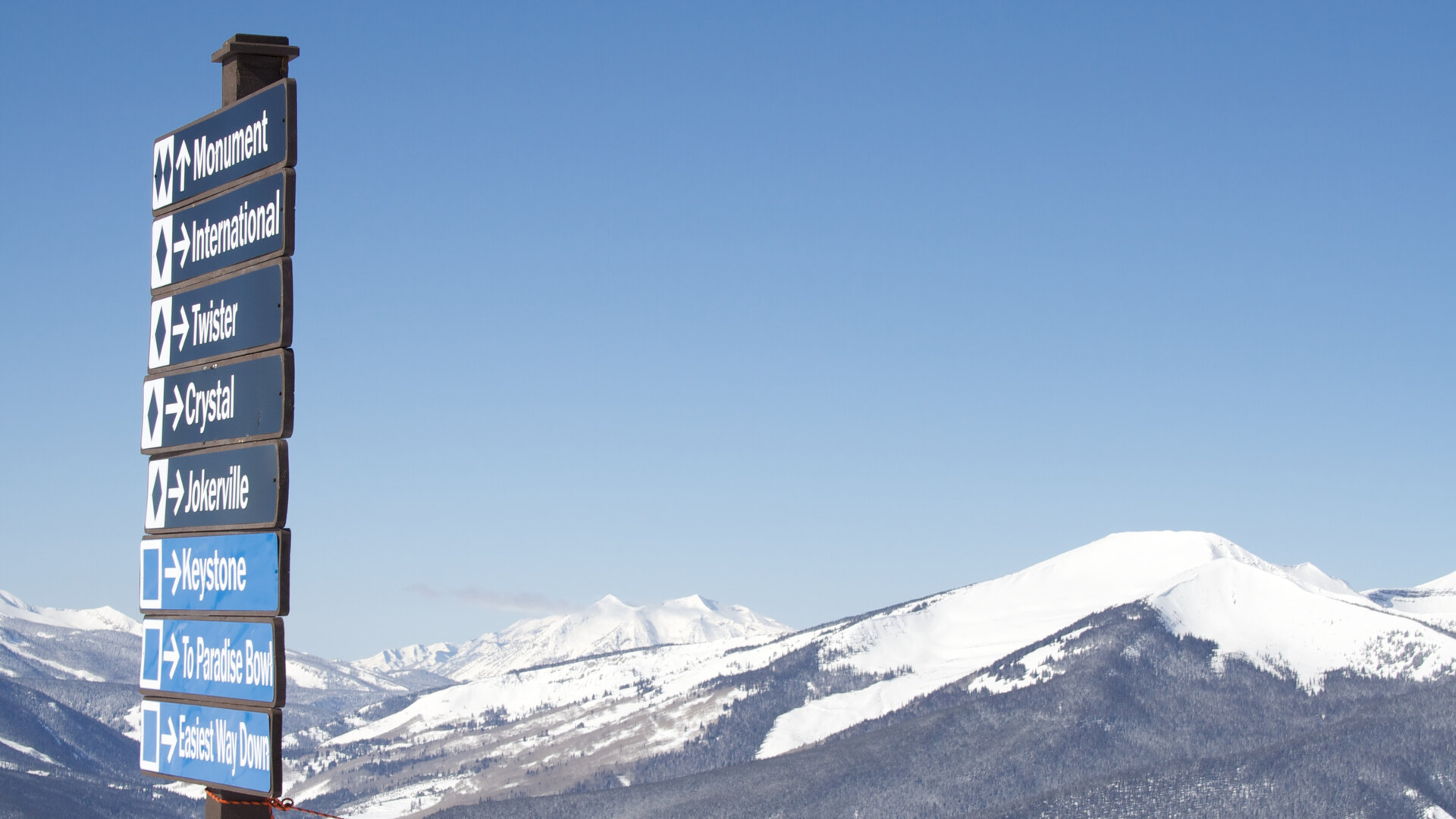
Trail signs at Crested Butte, Colorado, in March 2008: black diamonds, a double black diamond and blue squares. Photo: Peter from Wellesley via Wikimedia Commons, CC BY 2.0, cropped
A black run in the Alps and a black diamond in North America are about equally steep: both average close to 30 percent. The colors below black do not match. A European blue averages 15 percent, an American blue square 21. The reason is that Europe sets a steepness limit per color, while in North America each resort ranks its own runs.
In short
- We compared the map data of 42,894 ski runs in the Alps, the US and Canada. A black and a black diamond both average about 30 %.
- A European blue (15 %) is closer to an American green circle (13 %) than to a blue square (21 %). A European red (23 %) is close to a blue square.
- Austria and Italy cap a blue at 25 % and a red at 40 % on the steepest part. Switzerland counts in degrees (15° and 25°), France gives no number.
- In North America the colors are a ranking inside one resort. At Jackson Hole the blue squares average 29 %, as steep as a European black.
- In Austria and Switzerland a piste of any color, black included, is groomed. Steep, ungroomed terrain gets its own sign: the ski route. In North America a black diamond can be a mogul field that is never groomed.
The video shows all of it in about 4 minutes.
Black is black, blue isn't
We took the open map data of OpenSkiMap (a snapshot of October 2026) and computed the average gradient of every run from its elevation profile: the height difference between top and bottom, divided by the length. Then we took the median per color.
| Sign | Alps (AT, CH, FR, IT, DE) | US and Canada |
|---|---|---|
| Green circle / green | 12 % (mostly France) | 13 % |
| Blue / blue square | 15 % | 21 % |
| Red | 23 % | – |
| Black / black diamond | 30 % | 30 % |
| Double black diamond | – | 38 % |
So a skier who knows black diamonds will find European blacks familiar. The surprise is lower down: a European blue sits close to an American green circle, and a European red close to a blue square.
These are typical values, not the figure of one run. Map data are volunteer work, a run is often split into pieces, and the elevation model smooths short steep walls. The famous Streif downhill in Kitzbühel comes out at 68 % at its steepest in this data; the race organizers give 85 %.
In Europe, a color is a number
Austria's national standard for ski runs, ÖNORM S 4611, says a blue run may not be steeper than 25 percent, and a red not steeper than 40 percent, except for short sections. Anything steeper is black. Italy has the same limits in national law. Twenty-five percent means 25 meters down for every 100 meters across, about 14 degrees.
The limit is for the steepest part of the run. The average is lower, which is why the typical blue in the data averages 15 percent and not 25.
Even Europe disagrees
There is no single European rule. Switzerland's guidelines count in degrees: a blue may reach 15° and a red 25°. Twenty-five degrees is 47 percent, so a Swiss red can be steeper than an Austrian or Italian one. France rates its runs by technical difficulty and gives no gradient number in its public texts.
Italy shows how fragile the numbers are. A decree of 2023 lowered the blue limit to 15 percent. The Conference of the Regions wrote that the change was never justified and that government bodies had called it possibly a mere mistake. In 2025 the limit went back to 25 percent.
In North America, a color is a ranking
The Colorado Ski Safety Act defines the green circle as "the ski area's least difficult trails" and the black diamond as its "most difficult". Each sign must show "the relative degree of difficulty". There is no percent and no degree in it.
Resorts say the same in plain words. Timberline Lodge in Oregon writes that a green circle at Jackson Hole "might be as tough as a Blue Square at Sunlight". Lake Louise in Canada: "The designation of run difficulty is set by each ski area individually."
The map data agree. At Jackson Hole the blue squares average 29 %, the same as a typical European black, and the black diamonds average 44 %, steeper than three out of four blacks in the Alps. At Vail the green circles average 11 %.
A color is a range, not one number
Every class spreads wide. One in three American green circles is at least as steep as a typical European blue. One in eight European blacks is gentler than a typical blue square. In North America the sign ranks a run against its neighbors; in the Alps it sets a limit. Neither tells you exactly what is below your skis.
Japan, Australia and New Zealand
Japan's national ski safety standard uses green for beginners, red for intermediates and black for advanced runs, with a circle, a square and a diamond. In the map data they behave like the Alps: 16, 23 and 32 percent.
Australia and New Zealand use the American colors. Australian runs sit close to American ones (12, 19 and 32 %). New Zealand's are steeper: its green circles average 18 %, more than a typical European blue, and its black diamonds 41 %.
How to read a trail map abroad
Silvretta Montafon in Austria, a resort on the Epic Pass, gives its North American guests a flyer that pairs the signs: the Austrian blue next to the green circle, the Austrian red next to the blue square, black next to the black diamond.
| You know | In the Alps, start on |
|---|---|
| Green circle | Blue |
| Blue square | Red |
| Black diamond | Black |
Coming from Europe, read a blue square as a red. In both directions, check the resort, not only the color: Jackson Hole and Vail use the same signs for very different hills.
The sign with no American partner
In Austria and Switzerland a black run is a groomed run. Austria's standard ÖNORM S 4611 defines a piste as marked, checked, secured and "as a rule groomed". The Swiss guidelines are shorter: "pistes are groomed snow sports areas". Bumps can build up during the day, but the run itself is prepared by the resort. Italy is the exception in the Alps: it allows ungroomed pistes, and counts every one of them as a difficult, black run.
Steep, ungroomed terrain in Austria and Switzerland gets its own sign: the ski route, a yellow or orange marking. The Silvretta Montafon flyer calls it "marked and secured, not groomed and not controlled". The Swiss guidelines add that it gets no final sweep at the end of the day. In the flyer's North American column, that row is empty.
In North America a black diamond makes no such promise. The Colorado law asks only for "the relative degree of difficulty" for its signs. A black diamond can be a groomed run, a mogul field or a tree run. Lake Placid's official visitor guide describes the Upper Empire run at Whiteface, New York, as "black diamond, never groomed".
The Silvretta Montafon flyer also says that a rescue on the runs costs money without a piste rescue card (17 euros a season there). If black diamonds are your home terrain, read the ski-route sign twice.
Find the ski that fits
Steeper runs ask more of the ski and of its length. Our guide on finding the right ski length covers the length. The Ski Selector takes 2 minutes and suggests skis for the way you ski and where you ski.
Sources
- OpenSkiMap runs via the OpenSkiStats snapshot on Zenodo, record 23122524 (© OpenStreetMap contributors / OpenSkiMap, ODbL), zenodo.org, read on 13 November 2026. The medians are our own computation.
- ÖNORM S 4611 limits as quoted by Land Tirol, Pistengütesiegel report, read on 13 November 2026.
- Italy, Legislative Decree 40/2021, article 5, Normattiva, read on 13 November 2026.
- Italy, Conference of the Regions on the 15 % limit, regioni.it, read on 13 November 2026.
- Switzerland, SKUS guidelines 2025, skus.ch, read on 13 November 2026.
- France, Domaines Skiables de France, prevention memento, read on 13 November 2026.
- Colorado Ski Safety Act, Colorado Ski Country USA, read on 13 November 2026.
- Timberline Lodge, trail signage, read on 13 November 2026.
- Lake Louise, around the mountain, read on 13 November 2026.
- Japan, national snow sports safety standard, nikokyo.or.jp, read on 13 November 2026.
- Silvretta Montafon, flyer on piste markings, read on 13 November 2026.
- Hahnenkamm race organizers, the Streif, read on 13 November 2026.
- Lake Placid visitor guide (Whiteface), Upper Empire, read on 13 November 2026.