Ski Boots Too Big? The Shell Check and What to Do About It
Published
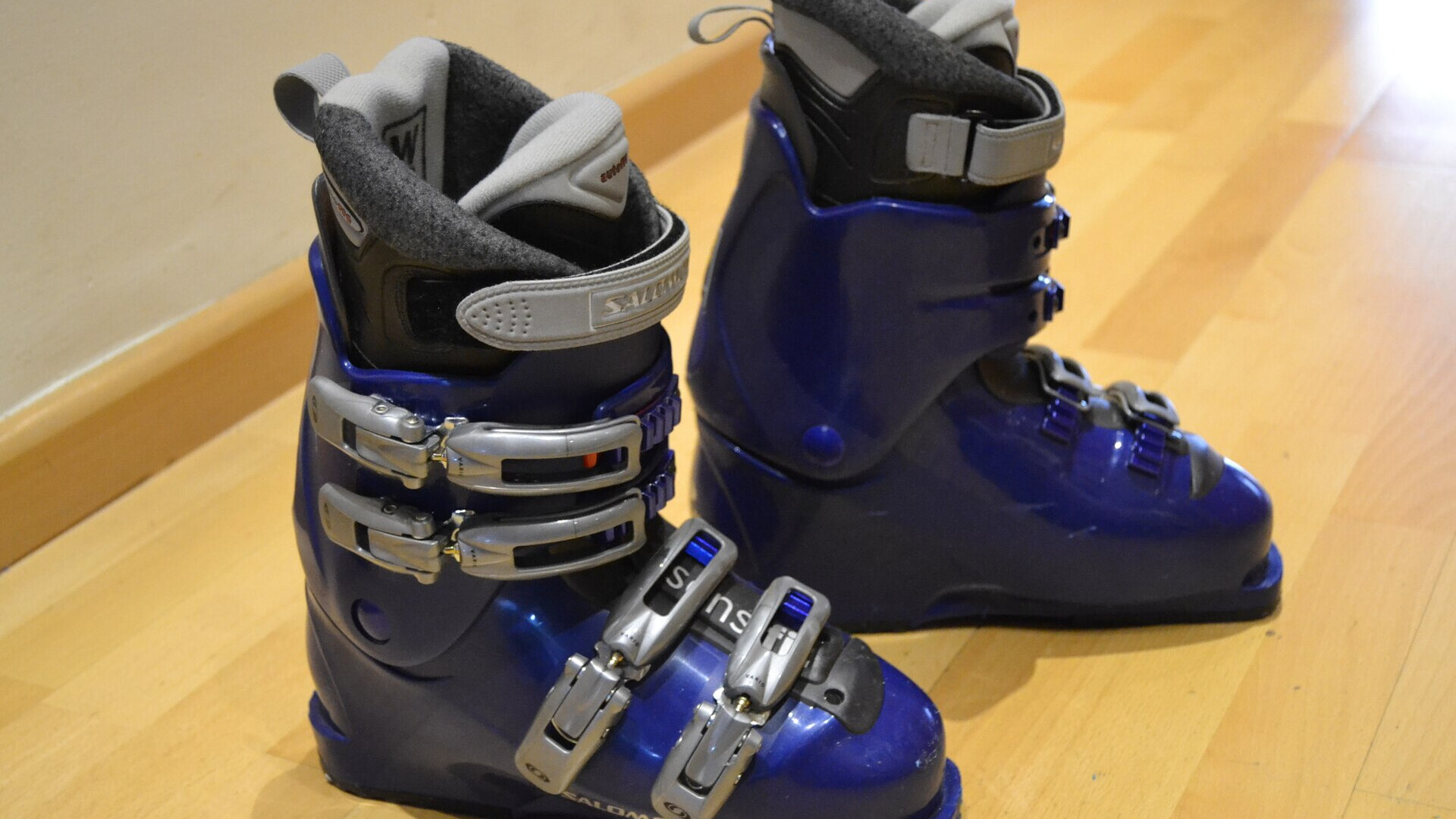
A pair of blue alpine ski boots, buckled, on a wooden floor, in December 2015. Photo: Fran C via Wikimedia Commons, CC BY 3.0, cropped
Salomon estimates that three in four skiers choose ski boots two sizes too big, and boot fitters say the same thing in their own words. You can check your own boots at home in a minute: take the liner out, stand in the empty shell with your toes at the front, and look behind your heel. One and a half to two centimeters is a good fit. Past two and a half centimeters, every source we read calls the boot too big.
In short
- Salomon, one of the largest boot makers, estimates that 75 % of skiers choose boots two sizes too big. It gives no source for the figure.
- Ski boots are sized in Mondopoint: the length of your foot in centimeters. Many makers build a whole size and the half size above it on the same shell.
- Most people need a boot size below their shoe size. Nordica's own chart gives two boot sizes for each shoe size, one full size apart.
- A new liner packs down after a few ski days, by about half a size according to boot fitters. The boot that felt great in the shop becomes loose.
- A boot fitter can fill a little room. A shell that is too long cannot be made shorter.
The video under the title shows the whole check in under 4 minutes.
How common are boots that are too big?
No survey has counted it. What exists are estimates from the people who see the most feet. Salomon's boot guide says: "It is estimated that 75% of skiers choose boots that are two sizes too big!" One boot shop in Hunter, New York, says that about 60 % of the boots from other shops that it works on have too much volume, and more than that among boots bought online. A Jackson Hole fitter told Gear Patrol that in eight out of ten cases the source of a skier's problems was a boot that was too big, often by about two sizes.
These are estimates and the samples are the people who come to a fitter with a problem, so read them as a strong signal, not as a measured share. They all point the same way.
Why the number on the boot misleads
Ski boots use Mondopoint, a sizing system in the ISO 9407 standard: the size is the length of your foot in centimeters. A 27 is for a foot of about 27 cm.
Many makers build two Mondo sizes on one shell. Atomic says it plainly: the 27 and the 27.5 have the same shell, and only a thicker or thinner insole changes. Tecnica's size chart shows the same in its sole lengths: the 27 and 27.5 share a 315 mm sole, the 28 and 28.5 a 325 mm sole. So half a size up often buys you only a thinner insole, and the next real step is a whole shell, a full centimeter longer.
| Mondo size | Sole length (Tecnica chart) |
|---|---|
| 26 and 26.5 | 305 mm |
| 27 and 27.5 | 315 mm |
| 28 and 28.5 | 325 mm |
Why your shoe size misleads
Most of us ask for the boot size that matches our shoes. A boot fitter at Aspen Ski and Board puts it plainly: "Most people are at least one full size down from their shoe size, and some are three or four." Even the makers build this in: Nordica's size chart lists two boot sizes for each shoe size, a "standard fit" and a "performance fit", always one full Mondo size apart. For a men's US 9 shoe, that is a 27 or a 26.
The moment in the shop
You step into the right size, and it hurts: your toes touch the front, and it feels too small. So you ask for the next size up, and that one feels great. That is the mistake. Fitters agree that a new boot is the tightest it will ever be. After a few days on the snow the liner packs down, by about half a size according to the same Aspen fitter. Salomon's own advice for skiers between two sizes takes that into account: it says to go half a size smaller.
Thick socks do not save a boot that is too big. As Blister's boot-fitting guide puts it, if a thick sock is there to take up room, the shell or the liner is too big.
What a loose boot does to you
- Your foot slides. On every turn the foot moves inside the boot, forward into the front, again and again. A podiatrist told Ski Magazine in April 2026 that in a loose boot "the foot jams excessively forward inside the boot and impinges the toe bones". Black toenails are a common result.
- Your heel lifts. Boot fitters name heel lift as one of the most common signs of a boot that is too big. It is not proof on its own: an ankle with little range of movement can cause it too.
- The ski reacts late. Your foot moves before the boot does, so the ski follows a moment later.
- You crank the buckles. To make a loose boot feel tight, skiers close the buckles a notch, then another. The boot is then too loose and too tight at the same time. A study from 1976 (Höflin and others) found that the pressure inside a buckled ski boot was, in some spots, higher than the blood pressure in the foot, and that blood flow in the foot dropped. When the boot was unbuckled, the flow came straight back. Fitters list cold, numb feet among the signs of a boot that is too big.
The shell check, step by step
- Pull the liner out of the shell.
- Step into the empty shell in your ski socks.
- Slide your foot forward until your toes just touch the front.
- Bend your knees, the way you stand on skis.
- Look behind your heel and measure the gap with a ruler, or ask someone to.
| Gap behind the heel | What fitters call it |
|---|---|
| 1 to 1.5 cm | Race fit |
| 1.5 to 2 cm | Good fit for most skiers |
| 2 to 2.5 cm | Comfort fit, on the big side |
| More than 2.5 cm | Too big |
The sources do not agree on the exact limit. One fitter and the Full Tilt fit guide call more than 2 cm (or more than two fingers) too big; others put the line at 2.5 cm or one inch. Fingers differ in width, so measure in centimeters.
What a boot fitter can and cannot fix
A fitter can fill a little room: a thicker footbed, pads around the heel, a shim under the liner. Fitters call these patches. As the Aspen fitter puts it, it is far easier to make a boot feel bigger than to make it feel smaller. Plastic can be pushed out where it presses. A shell that is too long cannot be made shorter, and with a large gap there is not much a fitter can do.
How to buy the next pair
- Stand on a sheet of paper with your heel against a wall, mark your longest toe, and measure. That length in centimeters is your Mondo size.
- Start from that number, not from your shoe size.
- Expect the right boot to feel tight in the shop, with your toes touching the front.
- If you fall between two sizes, even the makers do not agree: Salomon says go half a size down, Fischer says round up. Let a boot fitter decide with the shell check before you pay.
Find the ski that fits
A boot that fits is half of the setup. For the other half, answer a few questions in the Ski Selector and get skis that fit your level and your snow in 2 minutes. If you want to check the length too, read how long your skis should be.
Sources
- Salomon, "How to choose ski boots" (updated April 2025), salomon.com, read on 17 November 2026.
- Atomic, "How to find the right ski boot size", atomic.com, read on 17 November 2026.
- Tecnica, boot sizer 2023-24 (PDF), blizzard-tecnica.com, read on 17 November 2026.
- Nordica, boot size chart (PDF), nordica.com, read on 17 November 2026.
- Fischer, "Ski Boots: Fit well, ski well", fischersports.com, read on 17 November 2026.
- ISO 9407:2019, Mondopoint system of sizing and marking, iso.org, read on 17 November 2026.
- Aspen Ski and Board, "Your Ski Boots Are Probably Too Big" (August 2026), aspenskiandboard.com, read on 17 November 2026.
- The Pro Ski and Ride, "How to Know If Your Ski Boots Are Too Big" (June 2026), theproskiandride.com, read on 17 November 2026.
- The Ski Monster, "How Ski Boots Should Fit" (March 2025), theskimonster.com, read on 17 November 2026.
- Gear Patrol, "Why You Should Never Buy Your Ski Boots Online" (February 2018), gearpatrol.com, read on 17 November 2026.
- Blister, "Boot Fitting 101" (October 2022), blisterreview.com, read on 17 November 2026.
- Ski Magazine, "Do Ski Boots Cause Plantar Fasciitis?" (April 2026), skimag.com, read on 17 November 2026.
- Höflin F. et al., "Effect of flow material ski boots on foot circulation", Orthopedic Clinics of North America 7(1), 1976 (abstract), pubmed.ncbi.nlm.nih.gov, read on 17 November 2026.