Fluoro Ski Wax Ban: Why Racing Banned Its Fastest Wax
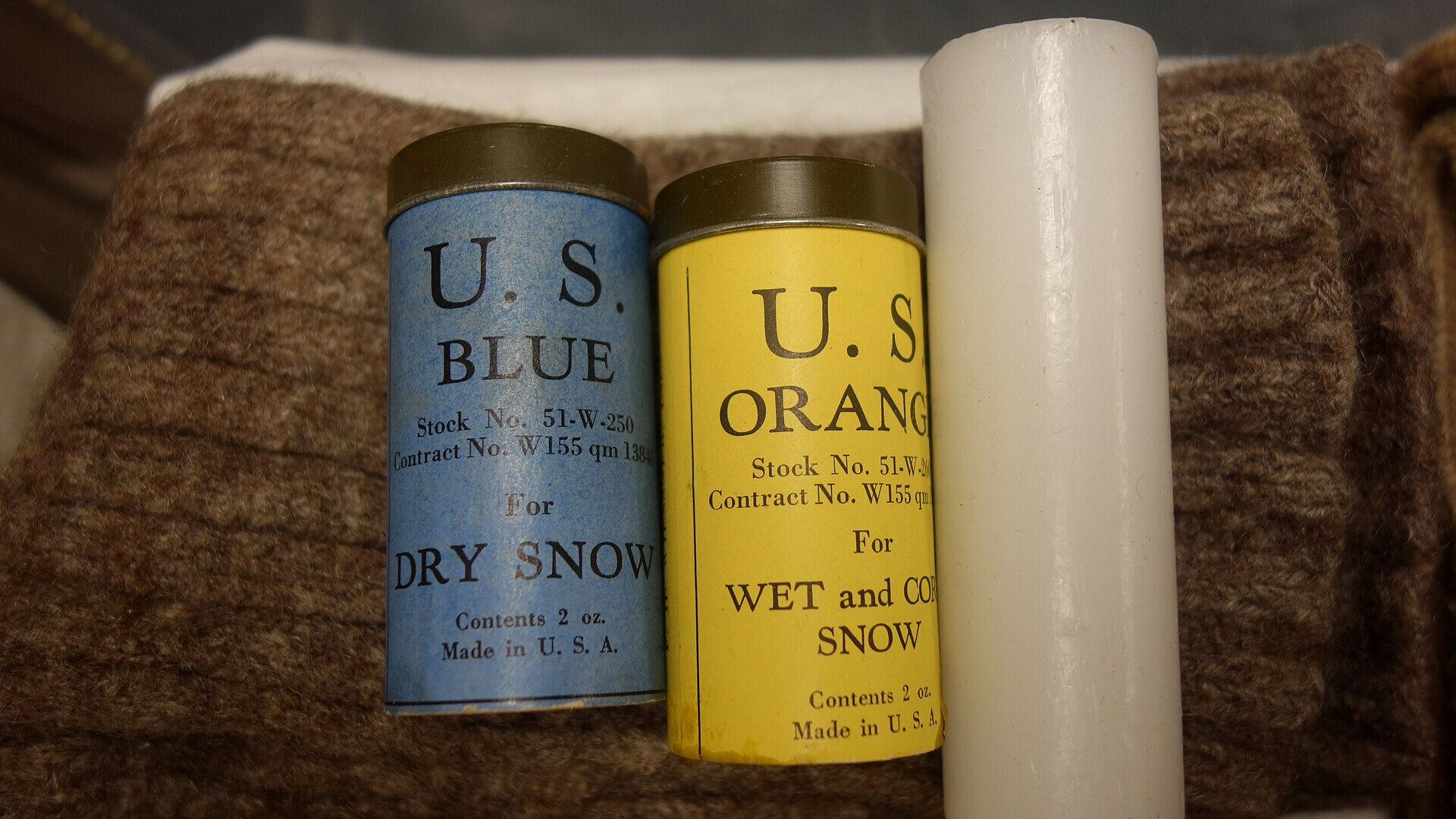
Old US ski wax tins in the Fort Devens Museum, Massachusetts, in 2013: blue for dry snow, orange for wet snow. Photo: Daderot via Wikimedia Commons, CC0, cropped
Fluoro wax was the fastest glide wax racers ever had. Since the 2023/24 season it is banned at every race of FIS, the international ski federation, and at every biathlon race of the IBU, and three red spots on an infrared scan disqualify a skier. It was banned for health and the environment, not for speed. And the first skier caught under the rule had clean wax on her skis.
In short
- Fluoro wax replaces part of the hydrogen in normal wax with fluorine. It sheds water and dirt, so it glides best on warm, wet snow.
- FIS announced the ban in 2019 and enforced it from the 2023/24 season. The IBU did the same.
- Wax technicians in a 2010 Swedish study had about 45 times more of one of these chemicals (PFOA) in their blood than the average Swede.
- Officials scan several spots on each ski. Three red spots mean disqualification. In the first season, FIS made 60,000 scans and found fewer than 10 cases in the World Cup.
- In France and in 4 US states, shops may no longer sell it. The race rule itself is for races only.
The video under the title tells the whole story in about 4 minutes.
The first skier caught: Sölden, October 2023
On 28 October 2023, Norway's Ragnhild Mowinckel was sixth after the first run of the season-opening World Cup giant slalom in Sölden, Austria. Then her skis failed the fluor test, and she was out: the first skier disqualified under the new rule.
The race director of her ski brand, Head, told TSN that the same skis had passed two days before, with the same preparation: "everything was green. Now it is dark red." What Head and FIS found later is the twist of this story, and it comes at the end of this guide.
What fluoro wax is, and why it glides
Normal glide wax is a hydrocarbon, close to candle wax. Fluoro wax swaps part of the hydrogen for fluorine. That puts it in the same chemical family as the coating of a non-stick pan: the PFAS, a group of about 15,000 "forever chemicals".
The trick is water. On wet, warm snow, a thin film of meltwater forms under the base and sucks at it, like a glass on a wet table. Fluoro makes the base shed that water, and the dirt in it, so the ski breaks free. That is why it worked best on warm, wet days.
| Wax type | What it is made of | Where it helped most |
|---|---|---|
| Normal glide wax | Hydrocarbons, like candle wax | All snow, at a lower speed |
| Fluoro wax | Hydrocarbons with fluorine in place of part of the hydrogen | Warm, wet and dirty snow |
| Fluoro-free race wax | New formulas without PFAS | All snow; makers say they are not yet as fast at the top level |
Speed you could buy
How much faster was it? Nobody can give a clean number, because no two race days have the same snow. But racers felt it. A former US racer told Grist: "The amount of speed you could buy on your skis was really ridiculous."
The powders were expensive, so at first only the big events used them. By 2006, nearly every racer did.
Banned for blood, not for speed
The ban was not about the speed. It was about the people who wax the skis and about the places where they ski.
In a study published in 2010, Swedish researchers took blood from 8 World Cup wax technicians every month for a season. Their median level of PFOA, one of the forever chemicals, was 112 nanograms per millilitre. The average Swede had 2.5: about 45 times less. A second study, also from 2010, linked the chemicals in waxers' blood to the air in the waxing room. The wax is melted onto the ski with a hot iron, and the technicians breathe in the fumes.
FIS gives the reason in its own words: these chemicals "fail to break down inside the human body". The US environment agency (EPA) warned in January 2022 that technicians and recreational skiers who apply such waxes can be exposed through handling the wax and through the vapours when it is melted.
Into the snow and the water
The chemicals do not break down outside the body either. From the ski, they go into the snow, the soil and the groundwater.
In 2021, Park City in Utah found PFAS in 3 of its wells, one of them near the start of a race course. Eleven of the 14 compounds matched a study of fluorinated racing waxes. That is not proof, but it is a strong hint. Samples in Europe found raised levels on ski slopes too.
How the scanner works
FIS announced the ban in 2019. It came into force 4 years later, for the 2023/24 season. The test is done right after the run, with an infrared scanner (Fourier transform infrared spectroscopy).
- The scanner reads several spots on each ski.
- Each spot is green or red. Red means a reading above the FIS limit.
- Three red spots, and the skier is disqualified.
In the first season, a FIS team of 8 people made 60,000 scans. In the whole World Cup, across all disciplines, there were fewer than 10 cases.
And your skis?
The FIS rule is for races. But the shops followed:
| Where | What changed | From |
|---|---|---|
| France | No making, importing or selling of PFAS ski wax | January 2026 |
| Minnesota | No sale of ski wax with added PFAS | 1 January 2025 |
| Colorado, Maine, Vermont | No sale of ski wax with added PFAS | 1 January 2026 |
The wax maker Swix says its new fluoro-free waxes are not yet as fast as fluoro at the top level, but plenty fast for the rest of us. None of its new products contain PFAS.
Do not melt an old tin in your kitchen
If you still have an old tin of fluoro wax, remember the EPA warning about the fumes when it is melted. Do not iron it on in your kitchen, or anywhere indoors without good air. For your own skis, a fluoro-free wax does the job.
Who gets caught: not the cheats
The scanner should catch cheats. Look at who it caught:
- Winter Games, February 2026. Two South Korean cross-country skiers were disqualified in the sprint. Their team said the wax was bought as fluoro-free, and their skis had passed every test before. Their results were later given back.
- A ski marathon in Switzerland, March 2024. 12 skiers were disqualified for fluor, the winner of the women's race among them. FIS gave 3 of them their places back days later.
So how does fluoro end up on skis that nobody waxed with it?
The twist: the wax was clean
Back to Sölden. Her ski brand went looking for the cause, and FIS checked the wax on her skis: it had no fluorine in it. The fluoro came from a waxing tool that had been used with fluoro wax before. Which tool it was, the reports do not say.
The fastest wax in history is gone from racing. But a trace of it, in one old tool, is still enough to take a race away.
Find the ski that fits
Wax makes a ski glide. The right ski makes it turn. Answer a few questions in the Ski Selector and get skis that fit your level and your snow in 2 minutes.
Sources
- FIS, "FIS widens scope of fluor testing after successful first season" (October 2024), fis-ski.com, read on 15 November 2026.
- IBU, full fluor ban from 2023/24 (March 2023), biathlonworld.com, read on 15 November 2026.
- TSN, Mowinckel disqualified in Sölden (28 October 2023), tsn.ca, read on 15 November 2026.
- Snowbrains, Head finds the cause of the contamination (4 November 2023), snowbrains.com, read on 15 November 2026.
- Grist, "The Olympics are ditching PFAS waxes" (February 2026), grist.org, read on 15 November 2026.
- Eos, "The Olympics just saw its first forever chemical disqualifications" (February 2026), eos.org, read on 15 November 2026.
- Nilsson et al., Environmental Science & Technology 44(6), 2010 (abstract), hero.epa.gov, read on 15 November 2026.
- US EPA, enforcement alert on ski wax (January 2022), epa.gov, read on 15 November 2026.
- Chemistry World, France bans PFAS in ski wax (February 2025), chemistryworld.com, read on 15 November 2026.
- Morgan Lewis, US state rules on PFAS in consumer products (January 2026), morganlewis.com, read on 15 November 2026.